Thurrock vape border testing contract: what the pending Lot 4 notice says about product checks at UK ports
Thurrock Council’s pending Lot 4 testing notice is a useful reminder for adult UK vape importers, wholesalers and retailers: visual checks matter, but product evidence files need to stand up to lab and technical scrutiny too.
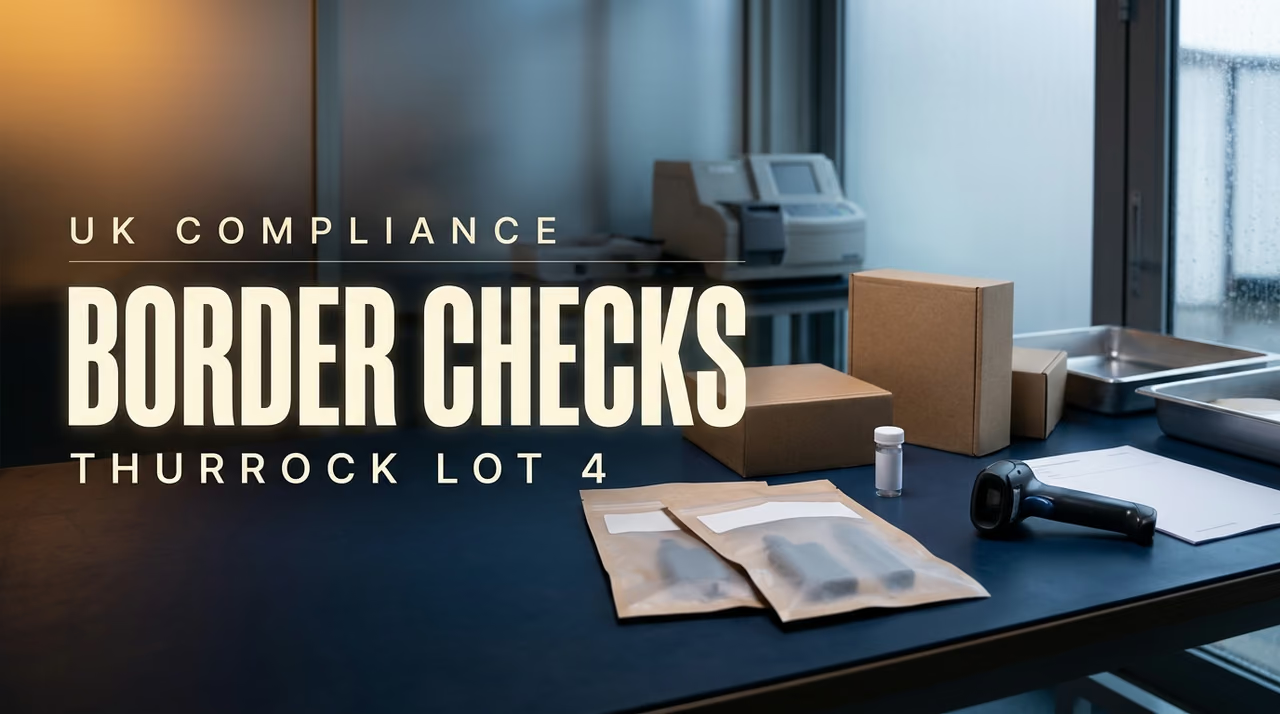
Thurrock Council’s consumer-product testing notice is not proof that every vape shipment entering the UK will be sent to a lab. It is more specific than that, and more useful for adult-only vape supply chains.
The Sell2Wales notice JUN631205 was first published and last modified on 26 June 2026. It names Thurrock Council as the buyer for “Various Consumer Product Testing Services”, including Lot 4 for “Jewellery and Vapes”. The visible notice still describes the Lot 4 contract as pending, with an estimated signing date of 18 August 2026 at 23:59, so this should not be treated as a confirmed signed contract unless Thurrock or the procurement record is updated.
What it does show is the direction of travel for product checks at busy border points. Labels, paperwork and visual inspection matter, but they are not always enough. Where officers cannot fully assess a consumer product from the outside, the notice is built around access to technical testing and laboratory services.
For UK adult vape importers, wholesalers and retailers, the practical takeaway is straightforward: build a product evidence file before stock is listed, not after a border query, Trading Standards visit or supplier dispute.
What Thurrock's Lot 4 notice actually says
The Sell2Wales record identifies Thurrock Council, authority ID AA20019, as the publisher of procurement reference PS-2025-193. The abstract says the contract is for product safety testing for Thurrock Council Trading Standards, covering four lots: toys, electrical and machinery, cosmetics, and Lot 4 for jewellery and vapes (Sell2Wales).
The same notice describes the work as grant-funded procurement for border controls at Thurrock border points, intended to check the safety of consumer goods. Its wording is important: officers can carry out labelling checks and visual examinations, but laboratory testing may be required where they cannot fully ascertain product safety themselves (Sell2Wales).
For Lot 4, the visible notice lists:
- Status: pending
- Related lot: 4
- Estimated signing date: 18 August 2026 at 23:59
- Value: £50,416 including VAT
- Main category: services
- CPV categories: technical testing, analysis and consultancy services; laboratory services
- Estimated contract dates: 1 September 2026 to 31 August 2028
- Possible extension end date: 31 August 2030
Those details make it a relevant compliance signal, but not a national announcement. It is a local authority procurement record for consumer-product testing at Thurrock border points. The vape-specific hook is Lot 4. The wider message is that product checks may need documentary, technical or laboratory support.

Why a visual check is not always the whole check
A visual check can still catch a lot. On vaping products, obvious warning-signs can include packaging that claims a nicotine strength above 20mg/ml, a refill container above 10ml, an e-cigarette tank or pod format above 2ml, missing or suspect labelling, or a product that appears to be single-use after the ban.
Those limits are not retailer folklore. The MHRA’s e-cigarette and vape guidance hub says Part 6 of the Tobacco and Related Products Regulations 2016 requires e-cigarette tanks to be no more than 2ml, nicotine-containing refill containers to be no more than 10ml, e-liquids to be no more than 20mg/ml nicotine strength, certain packaging and labelling controls, and MHRA notification and publication before sale (MHRA guidance hub; TRPR 2016).
But a box inspection cannot answer every question. A label might say one thing while the underlying formulation, batch record, ingredient dossier, emissions data or component specification says another. An officer may also need evidence that the product on the pallet is the same SKU, variant and batch covered by the supplier’s documents.
That is the point of the Thurrock notice. It does not name a vape test method, and businesses should not infer one. It simply shows that the border-control process can move from visual examination into technical testing where appearance and paperwork do not settle the product-safety question (Sell2Wales).
How this fits the wider OPSS border picture
The Thurrock notice also sits inside a wider product-safety border system. The OPSS Delivery Report 2025-2026, published on 5 August 2026, says OPSS works with local authorities and border agencies, funds local authorities at strategically significant border points, and uses HMRC and Border Force intelligence to target checks.
OPSS reported checks on consignments covering more than 11.3 million goods in 2025/26, with more than 2.7 million goods found unsafe or non-compliant (OPSS Delivery Report 2025-2026). Those are product-safety figures across goods categories. They should not be described as vape figures.
That distinction matters. The OPSS report gives the border-controls context. The Sell2Wales notice gives the vape-specific local procurement hook. Put together, they are a reminder that compliant vape supply is not just a retail-shelf issue. Evidence may need to stand up before products reach a warehouse, wholesaler catalogue or shop counter.
For a wider map of UK compliance bookmarks, see our guide to the CTSI vaping resource hub.
The vape evidence file: what to keep before listing stock
The best evidence file is boring, complete and product-specific. It should connect the product you are selling to the supplier, notification record, specification, batch and physical stock in front of you.
MHRA guidance says retailers do not need to notify products unless they are also producers, but they should check that relevant products are published on the MHRA notified-products list before procurement. It also says publication of a notified product does not guarantee compliance with UK labelling requirements, and retailers remain responsible for ensuring supplied products comply with UK regulations (MHRA retailer and producer advice).
MHRA’s due-diligence guidance goes further for suppliers and producers: notification information alone is not enough. It points to technical dossiers and supporting records such as specifications, batch testing, stability data, ingredient and component information, certificates, safety data sheets, toxicological risk assessments, manufacturing validation, complaint records and in-market compliance testing (MHRA Chapter 9 due diligence).
Role-by-role evidence file for UK adult vape supply chains

A retailer folder can be simple. It does not need to look like a laboratory submission. It should still answer the obvious questions: who supplied the product, what exactly was supplied, where is the relevant MHRA publication where required, what does the pack say, does the product match UK size and strength rules, and who can be contacted if Trading Standards asks for more?
GOV.UK’s general product-safety advice says businesses that make, import, distribute or sell consumer products in the UK are responsible for safety and labelling, and manufacturers and importers should keep technical documentation, apply appropriate labelling and provide safe-use instructions. It also says sellers should keep supplier-origin records for traceability and must not sell products they know, or should have known, are unsafe (GOV.UK product safety advice).
A practical pre-listing checklist should include:
- Product name, SKU, variant and batch or shipment reference
- Supplier invoice and contact details
- Manufacturer or importer details, where available
- MHRA notified-list reference for nicotine-containing products where relevant
- Product specification showing nicotine strength, container volume and tank or pod capacity where relevant
- Pack and label photos from the actual stock, not just a supplier PDF
- Reusable-vape evidence where the product is rechargeable and refillable
- Replacement pod, refill bottle or coil availability proof where relevant
- Notes of any query raised with the supplier, and the answer received
- Recall, complaint and corrective-action contact route

Reusable-vape checks should sit in the same folder
Since 1 June 2025, businesses must not sell, supply, offer to sell or stock single-use vapes for sale or supply in the UK. GOV.UK guidance says the ban applies to all vapes, whether or not they contain nicotine, and to retailers, manufacturers, wholesalers and importers (single-use vapes ban guidance).
That does not make this a disposable-ban article, but it does give a useful evidence-file example. GOV.UK says businesses must assist enforcing authorities during inspections and be able to provide evidence that a vape is legal and reusable, evidence of the steps taken to check, and proof that users can separately buy refill items such as pods or e-liquid refill bottles (single-use vapes ban guidance).
That evidence belongs beside the MHRA, supplier and labelling records. A reusable device claim is not just a marketing line. It should be backed by a rechargeable battery, refillable container, replaceable coil where relevant, and separately available refill or replacement items.
For more on the post-ban position, read our explainer on the UK disposable vape ban.

What this means for UK vape businesses now
The careful reading is this: Thurrock’s notice is a local border-testing procurement with Lot 4 covering jewellery and vapes. It is not proof that every vape consignment will be lab-tested, and the visible Sell2Wales record should still be described as pending with an estimated 18 August 2026 signing date unless a later primary source confirms otherwise (Sell2Wales).
The practical reading is stronger. If a product file only consists of a supplier spreadsheet and a catalogue image, it may not be enough when a regulator asks how the business checked the stock before sale. MHRA publication is necessary before supply for relevant nicotine-containing products, but MHRA itself warns that publication does not guarantee labelling compliance (MHRA retailer and producer advice).
Adult-only vape businesses should therefore treat evidence files as part of the buying process. Importers need the deepest technical records. Wholesalers need batch, supplier and UK-format traceability. Retailers need a lighter but usable check record that ties shelf stock to the supplier and the relevant compliance evidence.
The aim is not to predict which consignment will be opened or tested. It is to make sure that, if a question comes from the border, Trading Standards or a supplier recall, the documents are already in one place.
For adjacent retailer obligations, see our Tobacco and Vapes Act 29 October retailer checklist.
Build the evidence file before stock goes live
Use the official-source checklist approach: connect each SKU to supplier records, MHRA publication where relevant, label photos, reusable-vape evidence and a dated pre-sale check note before listing stock.
FAQs
Sources
- Sell2Wales notice JUN631205: Various Consumer Product Testing Services
- OPSS Delivery Report 2025-2026
- MHRA E-cigarette and Vape Products Guidance Hub
- E-cigarette and vape advice for retailers / producers
- MHRA Chapter 9: due diligence for vaping products
- Single-use vapes ban: information for businesses
- Product safety advice for businesses
- Product safety law: advice for manufacturers and importers
- Tobacco and Related Products Regulations 2016