Why sweet vape flavour demand still matters for UK adult vapers
Sweet vape flavours are not only a youth-policy issue. Adult surveys show fruit and other non-tobacco profiles remain prominent, but regulation must still account for youth appeal.
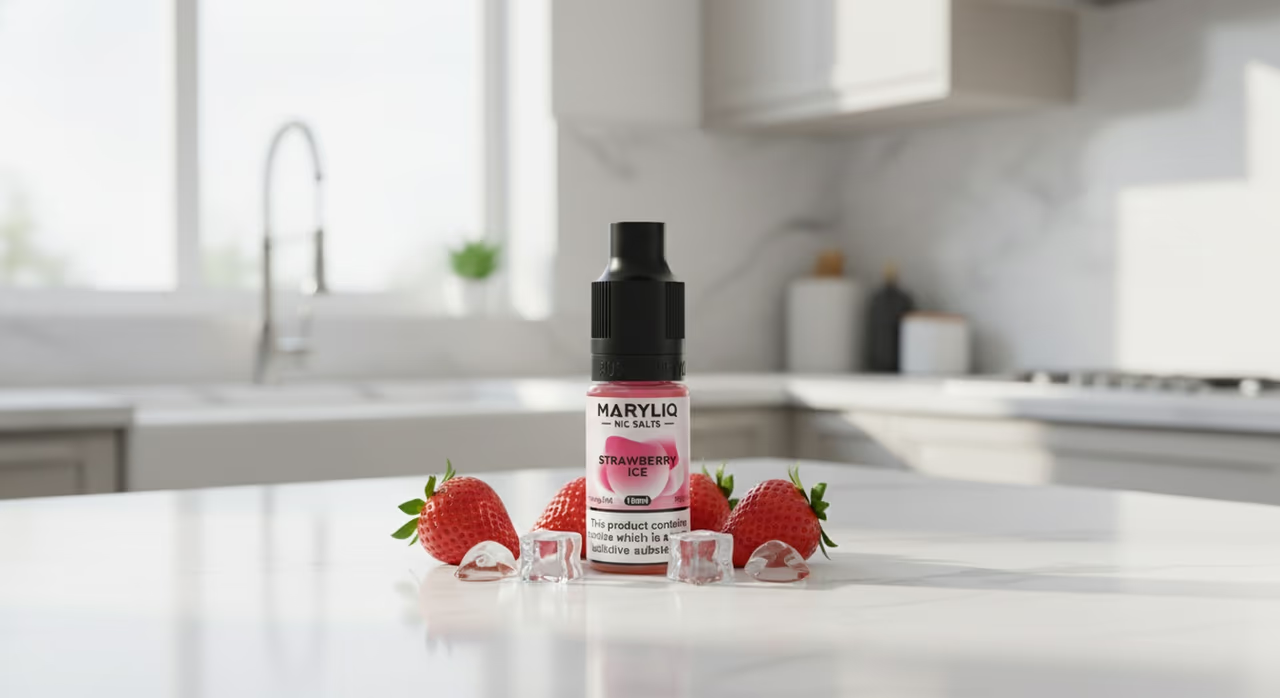
- Sweet and fruit vape flavours are not only a youth-policy issue: adult flavour surveys consistently show strong adult use of non-tobacco profiles.
- ASH's 2025 adult survey found fruit was the leading main flavour among GB adult vapers, ahead of menthol/mint and tobacco.
- GOV.UK/OHID's 2022 evidence update says there is some evidence that non-tobacco flavours, particularly sweet flavours, may play a positive role in switching from smoking to vaping, but that is not proof that any flavour causes quitting.
- The Tobacco and Vapes Act received Royal Assent on 29 April 2026. It creates powers to restrict vape marketing, packaging, displays and product features, but detailed flavour restrictions depend on secondary regulations and consultations.
- Youth appeal remains a real policy concern. Adult demand should be considered without turning sweet flavours into promotional claims or youth-coded marketing.
Sweet vape flavours sit in the middle of a difficult UK policy debate. On one side, ministers and public-health bodies are concerned that fruit and sweet flavour cues can make vaping more appealing to children. On the other, adult survey data shows that non-tobacco flavours are not a fringe preference among adults. They are part of how many adult vapers actually use the category.
That does not mean every sweet flavour should be defended, or that flavour preference data proves any health or quitting claim. It means the adult side of the evidence should not disappear from the conversation. If future rules restrict flavour names, ingredients, packaging, displays or permitted profiles, those decisions will affect adult vapers as well as the youth-protection problem they are designed to address.
The useful question is not "are sweet flavours good or bad?" It is narrower: what do adult flavour surveys show, what can those surveys prove, and how should adult demand be weighed now that the Tobacco and Vapes Act is law?
What adult flavour surveys show

The clearest starting point is ASH's 2025 survey of adult vaping in Great Britain. ASH reports that adult flavour preferences have changed substantially since 2016. In 2016, tobacco was the most common main flavour among adult vapers. By 2025, fruit was the leading main flavour at 51%, followed by menthol/mint at 20% and tobacco at 11%. ASH also says sweet, soft drink and alcohol flavour categories were at 9% in 2025.
That matters because "fruit" and "sweet" are often treated as if they only belong in a youth-marketing discussion. ASH's adult data shows otherwise. Fruit profiles are also common among adults who currently smoke and vape, and among ex-smokers who vape. The adult market is not simply a tobacco-and-menthol market with a small novelty tail.
GOV.UK/OHID's 2022 evidence update gives useful historical context for England. In the 2021 ASH adult data cited by OHID, fruit was the most popular adult e-liquid flavour at 35.3%, followed by menthol/mint at 22.5% and tobacco at 20.9%. The exact percentages have moved over time, but the direction is consistent: non-tobacco flavours are prominent in adult vaping.
There is also a 2026 industry-commissioned market signal reported by Better Retailing from Elfbar. It reported survey findings suggesting many adult vape users say fruit and sweet flavours help them move away from smoking or stay off tobacco. That kind of data is worth noting as a commercial and self-reported signal, but it should not be treated as neutral public-health proof. The more reliable editorial base is still ASH and GOV.UK/OHID.
Why flavour variety may matter for switching and repeat use

Flavour variety may matter because vaping is a repeated behaviour, not a one-off purchase. Adults who move from cigarettes to vaping have to find a product they will actually keep using instead of returning to tobacco. For some, a tobacco flavour may feel familiar. For others, a non-tobacco flavour may create distance from the taste and smell of cigarettes.
GOV.UK/OHID's wording is cautious and useful. Its 2022 evidence update says there is some evidence to suggest that non-tobacco flavours, particularly sweet flavours, may play a positive role in helping people switch from smoking to vaping. That is not the same as saying sweet flavours cause smoking cessation. It is evidence that flavour may be part of product acceptability for some adults.
There are several plausible, reader-friendly reasons. A flavour that is clearly unlike tobacco may make vaping feel less like smoking. Variety may reduce boredom for adult vapers who otherwise rotate back to cigarettes. Refill-liquid and pod users may also build repeat purchasing habits around flavour families they recognise.
Those points should stay in the lane of adult preference and self-reported experience. No article, retailer page or brand description should imply that a named product helps people quit unless the product is specifically authorised for that purpose. ASA/CAP guidance says smoking cessation or smoking reduction claims for e-cigarettes are medicinal claims unless the relevant product has MHRA authorisation.
The regulatory context changed in 2026


The legal context changed on 29 April 2026, when the Tobacco and Vapes Bill received Royal Assent and became the Tobacco and Vapes Act. GOV.UK says the Act includes measures to ban advertising and sponsorship of vapes and nicotine products, as well as powers to restrict packaging, branding and displays designed to appeal to children. It also introduces stronger enforcement powers, including the ability to implement retail licensing and tackle illicit tobacco and vape sales.
For flavour demand, the important detail is that the Act creates powers. It does not mean every sweet flavour is already banned. Detailed flavour restrictions, if introduced, depend on secondary regulations, consultations and official guidance.
GOV.UK's evidence material explains why this is a live policy area. Current TRPR rules already regulate several vape product features, including limits such as the 20mg/ml nicotine cap for nicotine e-liquids. They also ban certain ingredients in nicotine vapes, including colourings, caffeine and taurine. But the current framework has not operated as a simple permitted-flavour list for vapes.
That distinction matters for adult readers and retailers. The law has moved from debate into a framework with real powers, but the practical rules still need to be watched carefully. A responsible retailer should follow official updates, keep age checks tight, avoid youth-coded merchandising and be ready for future product or display changes.
The youth-protection concern cannot be ignored
Adult demand does not cancel the youth-protection concern. GOV.UK's evidence material says children are attracted to fruit and sweet flavours, and ministers have repeatedly framed the Act around reducing the appeal of vaping to children. The concern is not only the liquid itself. It also includes names, colours, packaging, displays, price promotions, influencer-style marketing and the way products appear near young people.
That is why the adult argument needs discipline. It is credible to say that fruit and sweet profiles are popular among adults. It is not credible to pretend that flavour appeal has no relevance to children, or that all criticism of sweet flavours is overreaction.
The better distinction is between adult demand and youth targeting. A compliant adult-facing vape market can discuss flavour preference without using childlike names, confectionery-style visuals or exaggerated sensory copy. It can sell to adults without making the category look like a snack aisle.
The same applies to imagery. An article about sweet flavour demand should not use bright candy piles, cartoon fruit characters, young models or school-adjacent scenes. A restrained adult retail or policy visual fits the subject better.
What this means for adult vapers and retailers
For adult vapers, the practical message is to pay attention to official rule changes rather than rumours. Flavour availability, packaging, displays and retail controls may change as secondary regulations are developed. Until detailed rules are made, avoid assuming that a specific flavour is banned or guaranteed to remain available.
Adults should also buy from compliant retailers and avoid illicit or obviously non-compliant products. The policy debate around flavours will become harder if the market is associated with underage sales, unlawful imports or packaging that seems designed to attract children.
For retailers and buyers, adult flavour demand remains commercially relevant, but it cannot be separated from compliance. The future winners are unlikely to be the loudest flavour marketers. They are more likely to be operators who can show disciplined age verification, careful product selection, restrained merchandising, supplier due diligence and quick response to new rules.
That also means avoiding overclaiming. A retailer can say that adult surveys show non-tobacco flavours are popular. It can say some adults report that flavour variety matters to their vaping experience. It should not say that sweet flavours are safe, risk-free, essential for quitting, or medically effective.
Bottom line
Sweet vape flavour demand still matters because adults demonstrably use and prefer non-tobacco profiles. ASH's 2025 data puts fruit ahead of tobacco by a wide margin among GB adult vapers, and GOV.UK/OHID's evidence review recognises a possible role for non-tobacco flavours in switching, while keeping the evidence cautious.
But that does not make sweet flavours a free-for-all. The Tobacco and Vapes Act is now law, youth appeal is a central reason for the new powers, and detailed flavour rules may follow through secondary regulation. Adult demand belongs in the policy conversation, but it has to be presented without youth-coded promotion, product-specific quitting claims or certainty the evidence does not support.
For adult vapers, the next step is simple: follow official updates and buy compliant products from age-verified retailers. For retailers, the next step is harder but more important: keep serving adult demand while making the shop, the language and the product range visibly adult-only and regulation-ready.
Related reading: why disposable vapes taste different, UK vape buying changes in 2026, vape advertising rules after the Tobacco and Vapes Act, and counterfeit-prevention controls for UK vape shops.
Source references
ASH: Use of vapes among adults in Great Britain 2025
GOV.UK/OHID: Nicotine vaping in England: 2022 evidence update summary
GOV.UK/DHSC: Tobacco and Vapes Bill becomes law
GOV.UK/DHSC: Tobacco and vapes: evidence to support legislation
ASA/CAP: Electronic cigarettes: Health and medicinal claims
Better Retailing: Survey finds 63% of vapers use sweet flavours to quit smoking (industry-commissioned market signal, used with attribution)