Is Scotland banning indoor vaping? What McConnell's call means
A former First Minister has called for Scotland to examine indoor vaping restrictions. Here is what is law now, what is still a proposal, and what retailers are saying.
- Scotland has not introduced a confirmed blanket indoor vaping ban from this story.
- Lord Jack McConnell is urging Scottish ministers to consider tougher vape restrictions, including the potential for an indoor ban.
- Scotland already has vape rules covering under-18 sales, proxy purchasing, seller registration and single-use vapes.
- The Tobacco and Vapes Act 2026 creates a framework for vape-free places, but the practical Scottish detail depends on regulations, commencement and consultation.
- Retailer response is split in a familiar way: support youth protection and enforcement, but push back on treating vaping as identical to smoking.
As of 13 June 2026, the careful answer is: no, Scotland has not introduced a confirmed blanket indoor vaping ban as a result of Lord Jack McConnell's latest intervention. What Scotland does have is a live political debate, existing rules on vape sales and retail registration, and a new UK-wide legal framework that can be used to make vape-free place rules.
That distinction matters. A headline about "banning vapes indoors" can make it sound as if the 2006 smoking ban has simply been extended overnight. The current position is more specific. McConnell, who was First Minister when Scotland's smoke-free public-place law came in, has called for Scottish ministers to look again at vaping restrictions. The Scottish Government and Parliament would still need to move through the relevant policy, regulation and implementation steps before ordinary adult vapers, venues and retailers could treat a Scotland-wide indoor vape ban as live law.
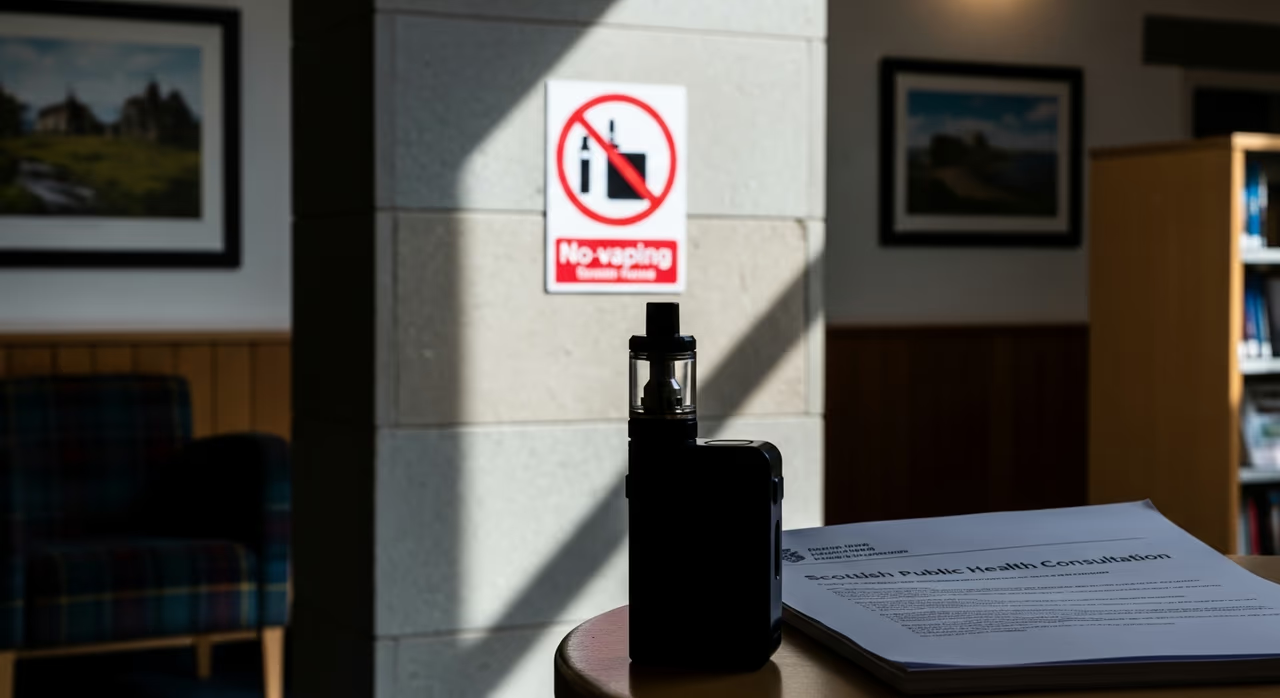
For adult vapers, that means venue policy still matters today. A pub, workplace, transport operator, hospital, campus or event can set its own no-vaping rule even where national law has not yet created a general indoor vaping ban. For retailers and hospitality operators, the practical job is to separate what is already required from what may come next.
What Lord McConnell actually called for
The current debate began with Lord McConnell urging Scottish ministers and political parties to consider stronger restrictions on vaping. STV reported on 22 May 2026 that he wanted Scotland to "follow my lead" from the smoking-ban era and look at measures including an indoor vaping ban, stronger protection for children and tougher action against those exploiting young users.
The original Enlighten article behind the story is important because it shows the status of the intervention. It is advocacy from a former First Minister, not a Scottish Government announcement. McConnell argues that the next Scottish Government should lead discussions on the potential for an indoor vape-use ban, improve enforcement funding, protect young people and future-proof legislation.
That is politically significant, but it is not the same as a rule changing on the day the article appears. The most accurate way to describe it is a call for ministers to examine tighter controls, with the 2006 smoking ban being used as the comparison point.
The comparison is easy to understand. Scotland's smoke-free law changed everyday behaviour in pubs, restaurants, offices and many other enclosed public places. But vaping was not treated the same way as smoking when that regime was created. That is why today's debate is not simply "has Scotland already done this before?" It is "should Scotland now create a statutory vape-free indoor-premises regime, and if so, where should it apply?"
What Scottish rules already cover

Scotland is not starting from a blank page. The Scottish Government's public vaping policy says vapes can help adults stop smoking, but children, young people and adults who do not smoke should never vape. That balanced wording is useful because it avoids two misleading extremes: vaping is not described as risk-free, but it is also not treated as identical to smoking for every purpose.
Several rules already matter for retailers. Sales of nicotine vapour products to under-18s are illegal. Proxy purchasing for under-18s is illegal. Sellers in Scotland must be on the Scottish Tobacco and Nicotine Vapour Product Register. Single-use vapes have been illegal to sell or supply since 1 June 2025.
Those are current compliance duties. They affect shop operations, staff training, supply choices and enforcement risk. A retailer cannot wait for a future indoor-use debate before getting age checks, registration and product sourcing right.
For adult vapers, current law and current venue policy still need to be kept separate. Some organisations already prohibit vaping on their premises under house rules or workplace policy. A hospital, council building, stadium, railway operator, pub or employer may apply a no-vaping rule even where the national position is not yet a blanket indoor ban. That rule may be contractual, employment-related or a condition of entry rather than a new Scotland-wide offence.
That is why a practical answer to "can I vape indoors in Scotland?" still has to start with the specific place. Do not assume allowed. Do not assume a new national ban has already begun. Check the venue's policy and signage.
What the 2026 Act changes

The Tobacco and Vapes Act 2026 is the reason this debate now has more than symbolic importance. The Act received Royal Assent on 29 April 2026 and gives governments across the UK new machinery for tobacco and vaping controls, including powers around vape-free places.
For Scotland, the key point is that the Act creates a framework for offences, signage and regulations around vape-free premises. It does not mean every indoor public place in Scotland automatically became vape-free the day the Act received Royal Assent. The detailed Scottish position depends on commencement, secondary regulations, exceptions and any consultation or guidance from Scottish ministers.
That distinction is not legal hair-splitting. It changes what readers should do. If a regulation later designates particular premises as vape-free, then operators may need signs, staff guidance and enforcement processes. Until that detail exists, the responsible wording is that powers and policy direction have moved, not that a universal Scottish indoor ban is already in force.
The England consultation is a useful boundary marker, but it should not be copied over as Scottish law. GOV.UK's England consultation on smoke-free, heated tobacco-free and vape-free places says health policy is devolved, applies to England only, and that devolved governments will carry out separate consultations in due course. That means Scottish readers should watch Scottish Government channels rather than assuming England's proposed list of places is Scotland's final list.
Why the debate is intensifying now
The policy pressure is not hard to explain. Official ONS figures released in November 2025 said that in Great Britain in 2024, 10.0% of adults aged 16 and over used e-cigarettes daily or occasionally, compared with 9.1% who were current smokers in that OPN series. ONS also cautioned that survey comparisons need care, but the broad policy signal is clear: vaping is no longer a niche behaviour.
That scale creates two political pressures at once. Public-health voices want stronger controls where vaping is visible to children or normalised among people who have never smoked. Retailers and harm-reduction advocates argue that adult smokers who have switched should not be sent the message that vaping and smoking are the same thing.
The Scottish Government's own wording sits between those poles. It recognises that vapes can help adults stop smoking while making clear that children, young people and adults who do not smoke should never vape. A good article, policy or retailer statement should preserve that distinction rather than using it as a slogan.
Retailer response: support enforcement, dispute equivalence


The retailer response reported so far follows a predictable but important line. Convenience Store reported on 29 May 2026 that VPZ, through Richard Begg, supported protecting young people and enforcing rules against retailers who break the law. At the same time, VPZ pushed back on regulating vaping as though it were identical to smoking and warned that indoor-ban calls could send the wrong public-health message to adult smokers who have switched.
That is a commercial stakeholder view, not neutral public-health evidence. It should be treated as one part of the debate. But it does highlight the policy trade-off Scottish ministers may need to manage: tighter youth protection and public-place controls without accidentally making adult smokers think there is no meaningful difference between smoking and vaping.
For responsible retailers, the stronger ground is enforcement and compliance, not broad health claims. A retailer can credibly say it supports age checks, action against illegal sales and clear rules. It should avoid saying vaping is safe, risk-free or medically guaranteed to help someone stop smoking. Those claims create regulatory and advertising risk.
What adult vapers should watch next
Adult vapers in Scotland should watch for four practical signals.
First, look for a Scottish Government consultation or statement on vape-free places. Because the England consultation is not itself Scottish law, Scotland-specific documents matter.
Second, watch for regulations or commencement provisions under the 2026 Act. Those will determine whether particular premises become legally vape-free, what signs are required and whether any exceptions apply.
Third, check venue policy. Even before any national change, a place can often prohibit vaping through its own rules. If a sign says no vaping, or staff tell you vaping is not allowed, do not rely on a general internet answer about national law.
Fourth, keep the youth-protection context in mind. The debate is being driven heavily by concerns about young people and non-smokers. Adult vapers who want rules to remain proportionate will not help that argument by vaping around children, ignoring signs or treating staff requests as a legal debate at the door.
What retailers and operators should watch next
Retailers should start with what is already definite. Check that the business is on the Scottish Tobacco and Nicotine Vapour Product Register if it sells nicotine vapour products in Scotland. Keep age-verification training current. Do not sell to under-18s. Do not allow proxy purchasing. Do not sell or supply single-use vapes. Keep supplier and product records in a form that can be explained to Trading Standards.
Operators such as pubs, restaurants, venues, workplaces, campuses and transport settings should review their current smoking and vaping policy. A policy that simply says "smoking ban applies" may not be clear enough for staff or visitors if vaping is treated separately. If the business bans vaping indoors as a house rule, say so clearly and consistently. If it permits vaping only in a designated area, explain that without implying a new national legal rule exists.
The next regulatory details to watch are signage requirements, definitions of premises, any exemptions, enforcement responsibilities and implementation dates. If Scottish ministers make regulations under the 2026 Act, operators may need to update signs and staff scripts quickly. The best preparation is a clean current policy and a named person responsible for monitoring official updates.
Bottom line
Scotland is moving in the direction of tighter vape controls, but the present position should not be overstated. McConnell's intervention is a call for action. The 2026 Act creates a framework. Existing Scottish rules already cover under-18 sales, proxy purchasing, seller registration and single-use vapes. A Scotland-wide indoor vaping ban still depends on the specific Scottish regulatory steps that follow.
For adult vapers, the practical next step is to check venue policy and watch for Scottish Government consultation or regulations. For retailers and operators, the useful next step is to tighten current compliance records, keep staff language accurate and avoid turning a political debate into a claim that the law has already changed everywhere.
Related reading: compare this with The Vapour Hut's guide to vape-free places in England, the wider UK Vape Laws 2026 overview, and background on the UK disposable vape ban.
Source references
Lord McConnell / Enlighten: New Parliament must work together on vape restrictions
Scottish Government: Vapes and vaping
Legislation.gov.uk: Tobacco and Vapes Act 2026
Convenience Store: Vape retailer issues response to call for indoor vaping ban in Scotland